Deutsch
 English
New TMLR Survey Maps the Future of Concept Bottleneck Models
What makes a machine learning model interpretable — and how can we tell whether its reasoning is actually understandable to humans?
These questions are at the center of Concept Bottleneck Models (CBMs), a family of interpretable learning architectures that make predictions through intermediate, ideally human-understandable concepts. The paper “What’s in the Bottle? A Survey and Roadmap of Concept Bottleneck Models” by Patrick Knab, David Steinmann, Christian Bartelt, Kristian Kersting, Bernt Schiele, Thomas Seidl, Udo Schlegel, and Wolfgang Stammer has been accepted at Transactions on Machine Learning Research (TMLR).
TMLR provides an international forum for the publication of high-quality scholarly articles across all areas of machine learning. The paper was published on OpenReview on 29 May 2026 and accepted by TMLR. (openreview.net)
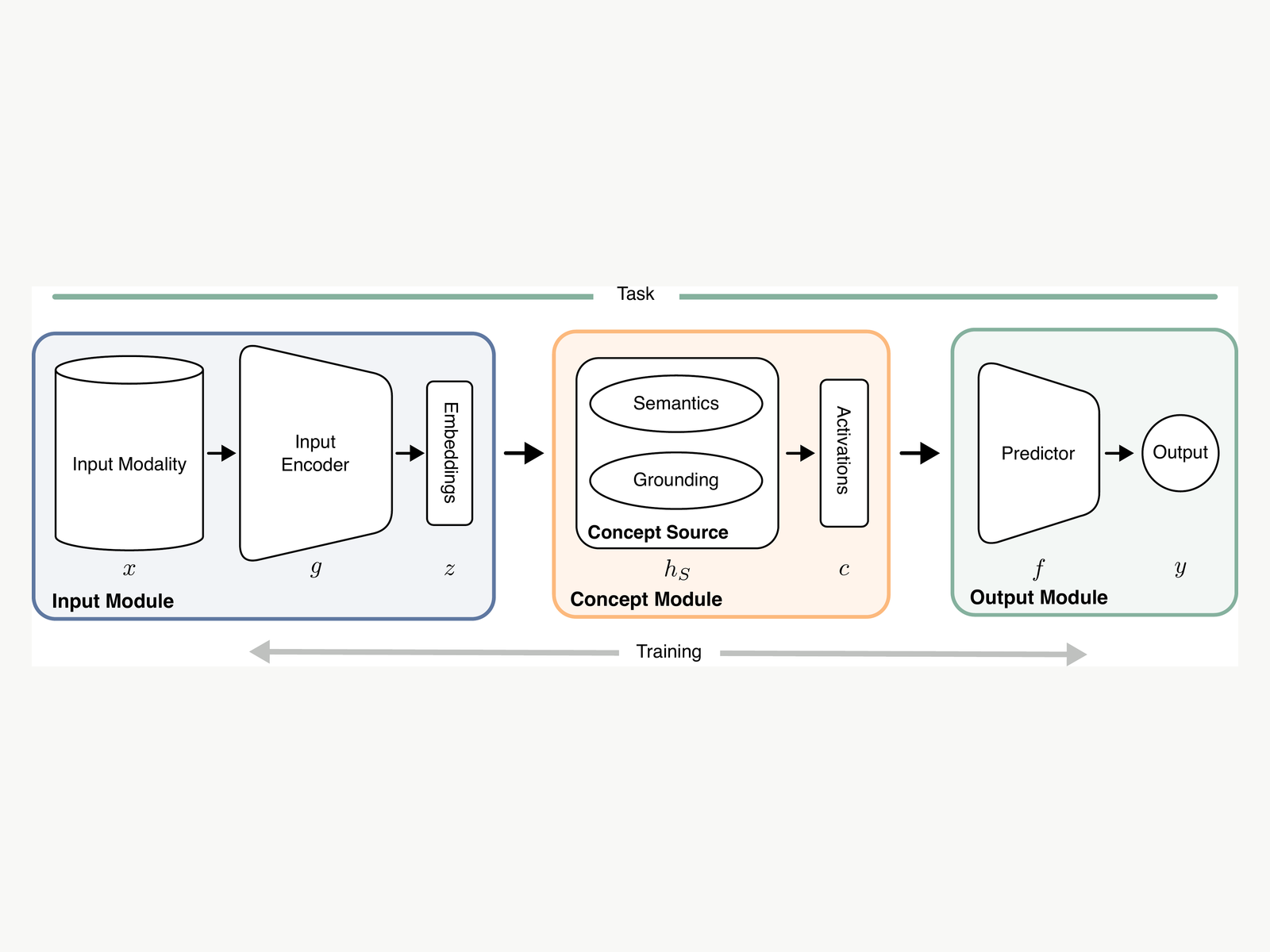
Concept Bottleneck Models factor predictions through intermediate concepts, making it possible to inspect parts of a model’s decision process rather than only its final output. As research on CBMs has grown, however, the field has also become increasingly fragmented, with many different methodological choices, assumptions, and evaluation practices.
This survey addresses that fragmentation by systematically reviewing the CBM literature, identifying core components and open challenges, and proposing a unified taxonomy for the field. Based on this taxonomy, the authors provide a detailed categorization of existing work and discuss current limitations of the CBM paradigm. The paper also outlines directions for extending CBMs beyond their current scope, including clearer evaluation practices and broader perspectives on interpretability.
Overall, the survey aims to consolidate the CBM landscape, clarify open issues, and provide guidance for developing future models.
The full paper can be read here.